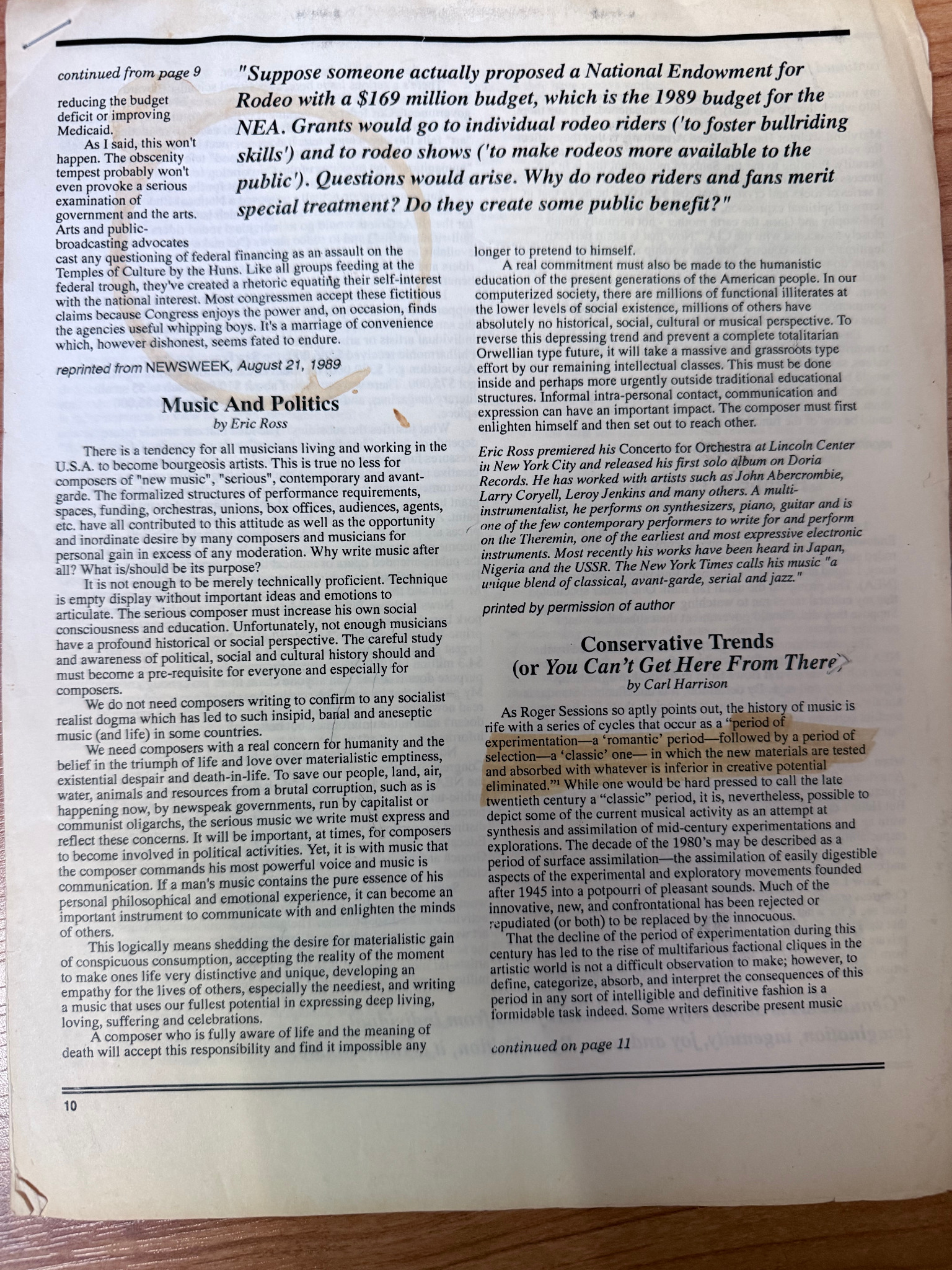
This article was written in 1989, when I was still using the name Carl Harrison — a name I was given when my stepfather adopted us, and which I later changed back to Faia. It was published in a music journal that year, and a copy has been traveling with me ever since: the worn, coffee-stained original you can see above.
I'm republishing it now for two reasons. First, because the arguments it makes about cycles of experimentation and conservatism in music feel remarkably current — the names have changed but the dynamics haven't. Second, because it forms the first document in what I'm thinking of as a loose series of pieces on music, genre, and where we are now: a 1989 essay about what happened to the avant-garde, followed by thoughts on what "a kind of music" means today, and eventually a reckoning with what AI is doing to all of it.
I've resisted the temptation to update or correct it. It is what it was.
Conservative Trends
(or You Can't Get Here From There)
"The history of music is rife with a series of cycles that occur as a 'period of experimentation — a romantic period — followed by a period of selection — a classic one — in which the new materials are tested and absorbed with whatever is inferior in creative potential eliminated."
— Roger Sessions[^1]
As Sessions notes, musical history tends to move in waves. While one would be hard pressed to call the late twentieth century a "classic" period, much of the current activity in music can be seen as an attempt at synthesis and assimilation of the mid-century avant-garde.
The 1980s in particular can be described as a period of surface assimilation: easily digestible aspects of post-1945 experimentation were smoothed into a potpourri of pleasant sounds. What was truly innovative or confrontational was often rejected — replaced by the innocuous.
That the decline of the period of experimentation during this century has led to the rise of multifarious factional cliques in the artistic world is not a difficult observation to make; however, to define, categorize, absorb, and interpret the consequences of this period in any sort of intelligible and definitive fashion is a formidable task indeed. Some writers describe present music practice as a form of "eclecticism" (perhaps "neoeclecticism" would be a trendier term) with the implication that this might be the new "common practice."[^2] Unfortunately, the term appears more often as an apology for content rather than an explanation of a valid artistic concept. While this is not an entirely satisfactory expression of the present state of our art music, it is, perhaps, indicative of the frustration experienced by artist and audience alike.
Artistic integrity and audience appeal make strange bedfellows. To retain the former while creating the latter is a goal of any artist (not so bold an assumption). If the result of the avant-garde was the success of the former at the expense of the latter, the present or postmodern era is full of examples of works which pander to the most accessible audience sensibilities. It is incredibly difficult to define the present state of musical affairs. Because of the constant state of flux and the inundation of conflicting information available to us all, the audience and the artist may very well lack the leadership common to past generations.
The manner in which society informs the arts is a matter of extended debate with as many opinions as writers. Allan Bloom declares that "classical music is dead."[^3] For many Americans this statement is probably not a threat nor is it a new concept. In fact, it is more common to view this as an inevitable result of contemporary culture due to the changing aesthetic values of the "thirtysomethings" and now the "twentysomethings."[^4] Artistic values have migrated in mass culture towards the entertainment aspect of creation — if it is art, it must entertain. This transvaluation of aesthetics is documented by Richard A. Peterson, who calls the newly emerging art music World Music. Peterson places in this new classification such diverse composers as Olivier Messiaen, John Cage, Philip Glass, Pink Floyd, Jimi Hendrix, and George Winston.[^5] This coalition of artists is not so bizarre if understood under the rubric of postmodernism, which reads, "Everything is Good." It is beyond the scope of this essay to discuss the value of these writers' opinions; they serve, instead, to illustrate the nature of the problem the artist faces today and the general attitude the public seems to have towards the artist.
In this age of pluralism, duplicity, and mass communication, definitive views, ideals, and aesthetics appear as unattainable entities. New aesthetics emerge and dissipate as quickly as television programs go in and out of fashion. It is possible to find an articulate defense of any work of art in a professional journal and a perfectly persuasive and valid argument against the work in the next issue of the same journal. This perpetual paradox is more prevalent today than in any other period in history because of the explosion of information made available to a "modern" society. The advent of mass communication has had an enormous influence in bringing disparate world societies closer (though not always an understanding of these societies). Everything from art to war, and their attendant detractors and defenders, enter our homes on a daily basis. Perhaps because of this new potpourri of possibilities, numerous contradictions in all the facets of day to day life are now normative.
Today, the world changes quicker and in a more capricious fashion than ever before. The artist exists within this relentless milieu of flux. Among a vast array of options, with near frightening possibilities, windows are opened and easily accessed by the artist. What was unattainable in the beginning of this century is now within reach of any semi-competent practitioner through the user-friendly electronics market. Yet artists must work much as they have always worked:
Creation is possible because within the limits of his artistic inheritance — his tradition — the artist is free to choose among the implications he can discover.[^6]
However, so many "implications" are presently available to the artist that, perhaps, the most significant amount of work done before creating a piece is deciding upon an alternative, an option, a technology, or an aesthetic value among the overwhelming resources at the artist's disposal.
Precompositional tactics or theories are most important in the act of creation. Unfortunately, the myriad of new possibilities may tend to distract from the purpose and vision of the artist. During the revolution in music (the avant-garde of the 1950s and 60s) every parameter of traditional music practice became suspect. Every preconceived or handed-down notion of the past was questioned and/or attacked. Nothing was sacred, nothing spared. Schoenberg had declared that the inevitable evolution of music was beyond traditional tonality and towards a new architectonic aesthetic. Then Boulez declared that "Schoenberg is Dead."[^7] And Babbitt didn't care if you listened.[^8]
Various composers and theorists provide various explanations and justifications for the apparent anarchy of the post-war modernisms. Leonard Meyer reviews many of the prevalent theories of the time and through dialectics reveals their many flaws.[^9] And again we are back to defenders (Boulez, Babbitt, et al.) and detractors (Meyer, Brindle, et al.) both with persuasive and strongly argued positions: on one side is progressive rationalism (which aims at improving the world in which man lives and believes that it is possible to build a better mousetrap) and on the other side both traditional and reactionary conservatism (preservation of the status quo whatever the cost). It appears, at this time, that of these two "isms" conservatism has won the argument for the day. Boulez inadvertently describes this present eventuality in the arts while talking about the early avant-garde movement:
…very early on, differences began to appear among us, stemming from the fact that some refused, in the name of humanism and the need to communicate with others, to advance any further where they risked not being understood — an ideology that filled me with horror, and that appeared to me above all to serve as a screen for conformity.[^10]
Differences have always been present within the realm of the musical establishment (the Council of Trent and polyphony, Artusi and Monteverdi, C.P.E. Bach and Rameau, Wagner and Brahms). What differentiates the past cycles of experimentation and assimilation from the present is the prevalence of particular ideals which "tend to throw the baby out with the bath water."[^11]
Instead of assimilation of the new possibilities, such composers as George Rochberg, John Corigliano, and David del Tredici (and others) have returned to the ideals of the late romantic era for inspiration and musical material. While this is not a unique phenomenon (composers continuously search the past for inspiration and reinterpretations of old ideas), the composers in question have eschewed the work and progress of their colleagues, as well as the plethora of new musical materials of the twentieth century, and returned to the comfort of the well-trod path of the nineteenth century. In a sense, these composers have unabashedly reinvented the wheel in the form of a key signature.
For the record, each of these composers has been trained and nurtured within the halls of academia. Each has composed serial music, an experience which seems to "empower" them to disavow its usefulness. And each has gained a certain amount of notoriety as a result of his reaction to the avant-garde. If one were to insert the names Glass, Reich, and Adams in place of the afore-mentioned composers nothing would change in this paragraph. Both groups of composers have reacted to the avant-garde by writing music which disregards all of its properties — good and bad.
Returning to the notion of the emergence of a new conservatism, there is a correlation between today's political/cultural climate and that of another time. In the late part of an earlier century a revolution had taken place and there was much bloodshed and anarchy. All the established norms were questioned and attacked. Tradition was thrown out and its proponents massacred. But there was little of substance in what replaced the old system. A radical ideology that held anarchy as its only liberator was doomed to fail in achieving any semblance of stability, growth, or progress. Shortly after this revolution two writers expressed their views of the consequences of such a bloody revolution. One writer claimed that the lack of tradition and proper procedures would only hinder the advancement of those ideals held important by the revolutionaries, namely freedom and progress. Yet he also proclaimed that it was necessary to improve, as well as preserve. The ideals themselves were not wrong, only the method in which they were implemented. The second writer also denounced the revolution and went on to denounce even the ideology of the revolutionaries. He claimed that even if the old system were wrong that it was better than causing any further suffering. He advocated the return of an authoritarian ideal (order) over liberal innovations (chaos).
The revolution is the French Revolution of 1789, and the two writers discussed above are respectively Edmund Burke (1729–1797) and Joseph de Maistre (1753–1821).
Burke represents traditional conservatism, holding on to a constitution while defending liberties. Maistre represents the reactionary conservatism of traditional authoritarianism, rejecting both the ideals and the innovations of any revolution. One fights for the rights of liberty and progressivism (albeit slowly and through a hierarchical constitutional tradition); the other reacts against any action towards a progressive rationalism.
It is Maistre's reactionary conservatism which is now a dominating force within society, culture, the political arena, and the arts. Postmodernism (a return to tradition) has replaced modernism (the avant-garde elite). Eight years of a conservative administration (Reaganism is conservatism) with more to come has helped to create a milieu of rabid reactionism. The National Endowment for the Arts is under attack (and precipitously close to collapse) from a senior senator from the south re-elected numerous times by a public fully aware of both his narrow-mindedness and his willingness to condemn art and artist without any firsthand experience or personal observation of the arts. To condemn out of hand a work of art because it falls outside the norms of tradition and threatens the status quo is a reaction founded in the conservative philosophy of Maistre.
The condemnation of the arts in general and the works of art in particular which question, prod, confront, and liberate is, perhaps, the most reactionary of legacies left by the Reagan era. This ideology of anachronistic archaism and reactionary sentiment so permeates the music world that modern accomplishments are forsaken and replaced by the values of an earlier era's aesthetics. Sure that the revolution is over and the avant-garde has lost the battle for liberation and independence, the neoclassical composers have come out of hiding and the new conservative composers (under the umbrella of eclecticism) may create works of great prettiness and little depth.
Indeed, the avant-garde may have lost the battle. Its own pretensions and extremes carried it down the irreversible path of audience rejection. An elitist attitude alone cannot carry an art form into the future. The alternative, however, taken by the composers mentioned above (for whatever reasons) may be without merit and/or audience as well. John Rockwell discusses del Tredici's Alice series in All American Music:
…once Final Alice had made its round of obligatory first performances… Del Tredici has hardly received many more performances than [Elliott] Carter… The conductor Erich Leinsdorf played Final Alice but then dismissed it as "in my personal opinion totally without merit, parlaying the major-sixth chord into a fifty-eight-minute work…"[^12]
It is difficult, if not impossible, to approach and judge, either subjectively or objectively, a work of contemporary art. Whether this is due to a lack of confidence in our ability to make aesthetic judgements, or a need of distance (time) to make these judgements is a matter of debate. The multitude of options and choices of the artist during creation and the same multitude of choices and options in placing justifiable values upon the work are numbing. It is much easier to ignore the very existence of any art and thereby reduce the necessary energy required to make personal value judgements. It is much easier to plug in the Walkman and block out the chattering of the world than it is to partake in such a maddening and exasperating quest for progress and stability.
Boulez describes the situation with characteristic precision:
Today, there exist two very different currents [in music], one neoromantic, the other what I call primitivistic, represented by the Americans and corresponding to "minimal art" in the plastic arts. Neoromanticism… only repeats the errors of the neoclassicism that existed between the two wars… I can explain it to myself only as a reaction born of fatigue, of impotence in the face of a technique not sufficiently mastered to allow one to do what one wants with it. Hence the neoromantics take refuge in history… As for the other movement, that of the Americans, it is born of a reaction against a certain complexity of language… It tends to reduce musical elements to a minimum and to return to extremely rudimentary bases of language… This attempt at radical simplification is not uninteresting, but I find it inadequate. In fact, the complexity of the language disturbed these composers, and they tried to reduce it and to substitute for it a complexity of a different order, which they found, specifically, in rhythm. But one cannot found a language upon a single element, and there rises the inadequacy. Thus, of the two present-day movements, one exhibits a historical weakness, the other a weakness of constitution. In addition both define themselves in reaction to something, which is not very meaningful… If you set as your goal a reaction against the mannerisms of a generation, all you will bring about is a new mannerism.[^13]
More paradox? More contradiction? Though Boulez tends to be polemical and hard-edged he makes some rather salient points. The inability to manipulate a new and ever-expanding language is, in itself, not a tragic flaw. To ignore and denounce the progress made in formulating new musical materials is, however, a reactionary aesthetic which runs counter to the very essence of being an artist.
The creative musician… must conceive and translate. His world is dualistic. He must be able to live and grow in an acutely focused, subjective world arising out of an intense emotional field of activity. At the same time he must be so stimulated by this world that he naturally possesses a sustained interest strong enough to impel and guide him through a lifetime of searching for an adequate musical vocabulary…[^14]
Lists and artificial criteria rarely define a work of true art. What defines a great work of art might be its indefinability — or it might be a great work of art…
…precisely because the creator has dared to choose beyond the limits and bounds of the normal, the accepted, and the obvious. In so doing the creator… frees us from the determinism of the probable and the routine and makes significant changes in culture possible.[^15]
Bibliography
- Bloom, Allan. The Closing of the American Mind. New York: Simon & Schuster, 1987.
- Boulez, Pierre. "Schoenberg is Dead." The Score 5/6 (1952): 18–22.
- ———. "From the Domaine Musical to IRCAM: Pierre Boulez in Conversation with Pierre-Michel Menger." Translated by Jonathan W. Bernard. Perspectives of New Music (Fall/Winter 1990): 6–19.
- Cope, David. New Directions in Music. 5th ed. Dubuque: Wm. C. Brown Publishers, 1989.
- Dahlhaus, Carl. Analysis and Value Judgement. Translated by Siegmund Levarie. New York: Pendragon Press, 1982.
- De Ventós, Xavier Rubert. Heresies of Modern Art. Translated by J. S. Bernstein. New York: Columbia University Press, 1980.
- Ellis, Bret Easton. "The Twentysomethings: Adrift in a Pop Landscape." New York Times, 2 December 1990.
- Foster, Hal, ed. Postmodern Culture. London: Pluto Press, 1983.
- Harris, Roy. "The Basis of Artistic Creation in Music." In The Basis of Artistic Creation, 19–30. New Brunswick: Rutgers University Press, 1942.
- Meyer, Leonard B. Emotion and Meaning in Music. Chicago: University of Chicago Press, 1956.
- ———. Music, the Arts, and Ideas. Chicago: University of Chicago Press, 1967.
- Morris, Valerie B. and David B. Pankratz, eds. The Future of the Arts: Public Policy and Arts Research. New York: Praeger, 1990.
- Rochberg, George. The Aesthetics of Survival. Ann Arbor: University of Michigan Press, 1984.
- Rockwell, John. All American Music. New York: Alfred A. Knopf, 1983.
- Sessions, Roger. Collected Essays. Edited by Edward T. Cone. Princeton: Princeton University Press, 1979.
[^1]: Roger Sessions, Collected Essays, ed. Edward T. Cone (Princeton University Press, 1979), 46. [^2]: Joseph Schwantner, for one, employs the term to defend John Corigliano's music (liner notes to the Pied Piper Fantasy). [^3]: Allan Bloom, The Closing of the American Mind (New York: Simon & Schuster, 1987), 69. [^4]: Bret Easton Ellis, "The Twentysomethings: Adrift in a Pop Landscape," New York Times, 2 December 1990. [^5]: Richard A. Peterson, "Audience and Industry Origins of the Crises in Classical Music Programming: Toward World Music," in The Future of the Arts, ed. Morris & Pankratz (Praeger, 1990), 207, 222. [^6]: Leonard B. Meyer, Music, the Arts, and Ideas (University of Chicago Press, 1967), 59. [^7]: Pierre Boulez, "Schoenberg is Dead," The Score 5/6 (1952): 18–22. [^8]: It should be pointed out that the original title of the essay in which Milton Babbitt compares the composer of new music to a research scientist is "The Composer as Specialist" but was changed by the editors of High Fidelity (to "Who Cares if You Listen") when they first ran the article in February 1952. This stereotypical action of the editors was perhaps the true source of the widespread repercussions of the article rather than Babbitt's straightforward argument for the modern composer. [^9]: Meyer, Music, the Arts, and Ideas, 245. [^10]: Pierre Boulez, "From the Domaine Musical to IRCAM," Perspectives of New Music (Fall/Winter 1990): 7. [^11]: I first heard this description of the present state of musical values in a conversation with Ellsworth Milburn. [^12]: John Rockwell, All American Music (New York: Alfred A. Knopf, 1983), 79, 81. [^13]: Boulez, "From the Domaine Musical to IRCAM," 12–13. [^14]: Roy Harris, "The Basis of Artistic Creation in Music," in The Basis of Artistic Creation (Rutgers University Press, 1942), 26. [^15]: Meyer, Music, the Arts, and Ideas, 59–60.