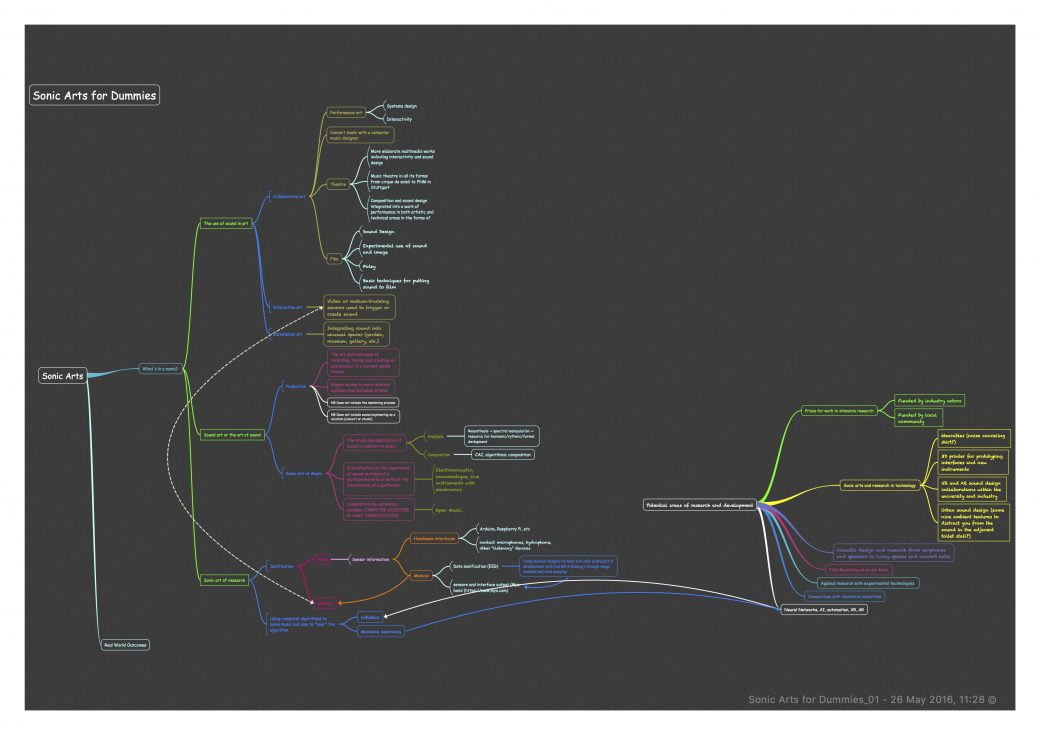
…or Sonic Arts for Dummies (a work in progress). How do you describe Sonic Arts? What is it, how does it work? What do you do with it? Trevor Wishart might have coined the phrase and wrote the book, but shadows persist.[^1]
It seems that the easy definitions include rock/pop/electro-anything and splashes in a little producing for good measure. This would work if we lived in a mono-dimensional world with history starting a few decades ago. Defining Sonic Arts around pop music with electronics is like defining contemporary as today's popular music or defining classical music as any music that is old and played by orchestras. Wishart defines Sonic Art:
To avoid getting into semantic quibbles, I have therefore entitled this book On Sonic Art and wish to answer the question what is, and what is not, 'sonic art'. We can begin by saying that sonic art includes music and electroacoustic music. (Wishart 1996: 4)
That would have been great, if he had stopped there. But then he breaks it up in two groups (text-sound and sound-effects) and before long we are in a world that can be as exclusive and hermetic as pop music with electronics.
I'm working through the problem. I've played around with some mind mapping for fleshing out something that should be as exclusive as it is inclusive. Having borders is fine and sometimes necessary, but not everywhere and not all the time.
Some things that fall within Sonic Arts, as I understand it:
- Computer programming as a central skill, part of the craft developed in the art
- A composer wants to add amplification to an instrumental ensemble for a special effect — room acoustics and psychoacoustics are in play
- A scientist develops an analysis/resynthesis technique to morph phonemes for speech research; composers may use the same technology to morph instruments
- A composer creates a series of harmonic progressions from a spectral analysis of one note played on a contrabass
- A theatre director wants an actor's movements to trigger sound (or light or video)
- A dancer wants to use her movements to control a complex algorithm providing music and image creation during a performance
- A biologist wants to know what the life cycle of an infected cell sounds like compared to a healthy cell in researching an advanced warning system
- A game designer wants to develop an immersive environment that places acoustic space at the centre of the game's strategy
- An installation artist wants to use sound as the driving force of an interactive sound and video piece in a gallery
The list goes on — and keeps expanding. That's rather the point.
[^1]: Wishart, Trevor. 1996. On Sonic Art. New and revised edition. Contemporary Music Studies 12. Amsterdam: Harwood Academic Publishers. A great book with a lot of information on Wishart's techniques, and also interesting for the snapshot of what it was like to work with computers in the 1980s (first published 1985).