 Karlheinz Stockhausen
Jonathan Harvey (1939–2012) looks at and decrypts the early work of Karlheinz Stockhausen (1928–2007).[^1] Introductory style, with Harvey's wonderfully clear and insightful explanations and lots of musical examples. A great book to have at hand. I started looking for this one about a year ago and it was selling for some crazy price. I finally found it at a reasonable price — if you can find it, grab it.
A short note on the book and why you should have it
In 1975, Harvey was in his mid-thirties and a Senior Lecturer in Music at the University of Southampton. Mortuos Plango was still five years from being composed. Stockhausen was in his late forties with over 25 years of major compositions behind him. Harvey dissects the German composer's works including Kreuzspiel (1951), Gruppen (1955–1957) and Gesang der Jünglinge (1955–56).
The book is all of 144 pages including the index and is approachable as well as succinct. Harvey gets quickly to the point of each piece or topic and then provides clear graphics for formal or technical aspects of his analysis.
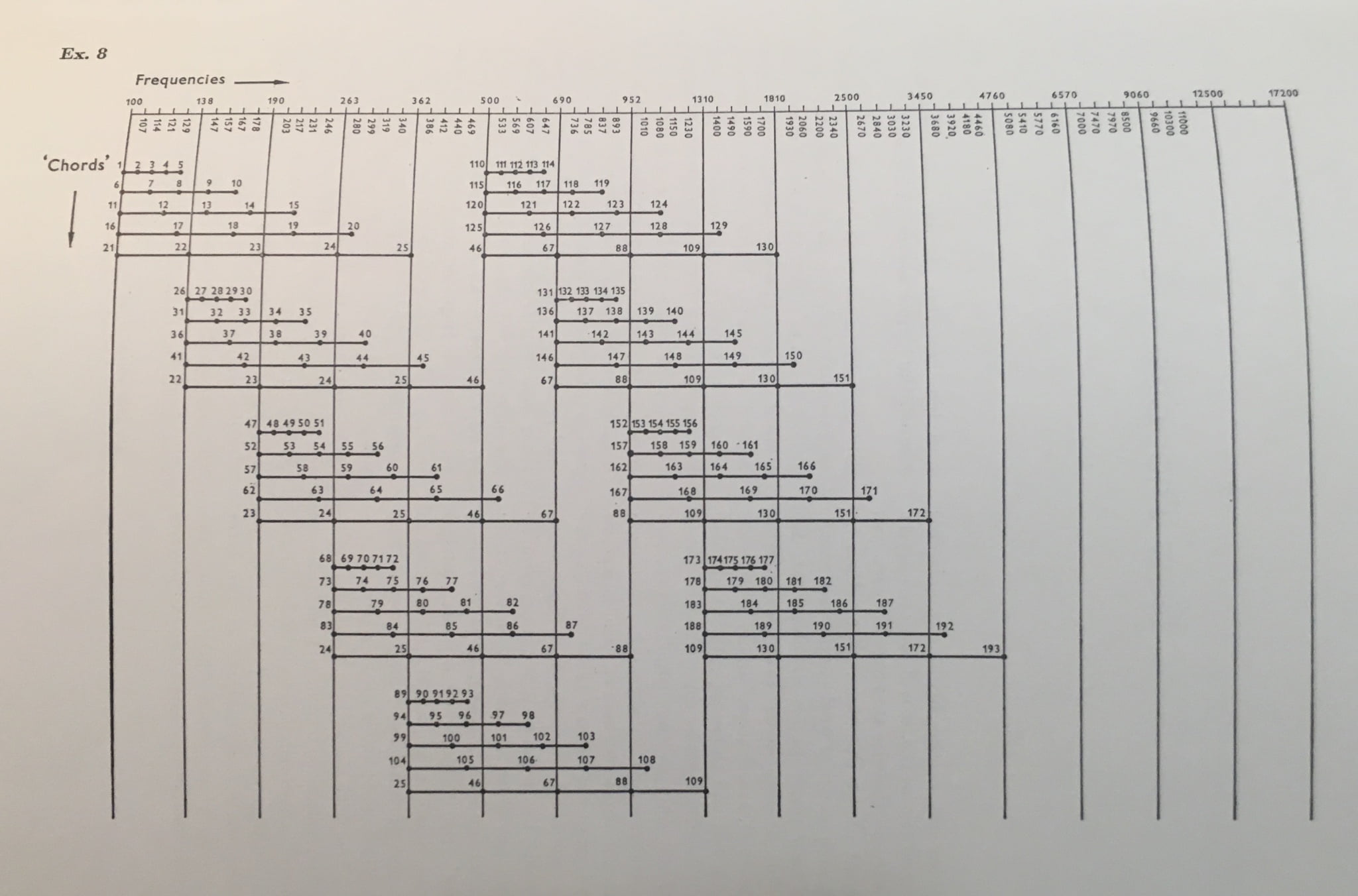 Harvey's analysis graph for Stockhausen's Electronic Study No. 2
His analysis of Gruppen is full of great insights and helpful examples. He also goes through some of the later electronic and mixed pieces, including a very clear explanation of Nr. 19 Solo (1966) — a good place to start for anyone performing or arranging this incredible work.[^2] There is a list of compositions up to 1974, an appendix on Mantra (1970), a bibliography and a discography: everything you need to get into Stockhausen's early works.
I have a particular affection for both figures in this book. I worked with Jonathan Harvey on several occasions — including The Summer Cloud's Awakening and Two Interludes for an Opera — and consider him one of the most generous and intellectually rigorous composers I have encountered. As for Solo: at IRCAM in the late 1990s, I realised what is believed to be the first complete version of the piece for computer, porting it from its original tape delay system to Max/MSP. Harvey's chapter on it was one I returned to more than once during that process.
[^1]: Harvey, Jonathan. The music of Stockhausen: an introduction. Faber, London, 1975. [^2]: Ibid., 97.